
Part One: The Scene I Wasn’t Supposed to See
When I left work early that Tuesday, I imagined spending a peaceful evening with my mother.
A meeting had been canceled at the last minute, so I stopped at her favorite Thai restaurant and picked up enough food for both of us. Mom had mentioned that her lower back was bothering her again, and I thought she might enjoy having dinner brought to her instead of standing in the kitchen.
In my mind, the evening was already planned.
We would sit on the couch, eat noodles straight from the containers, and laugh while she complained about the dramatic judges on the television shows she loved.
But the moment I stepped through her front door, I knew something was wrong.
The door was unlocked.
From inside came the sound of children shouting, something hitting the floor, and a high-pitched voice screaming, “He touched my dinosaur!”
Another child immediately yelled, “I had it first!”
I pushed the door open with the takeout bag balanced against my hip.
Then I froze.
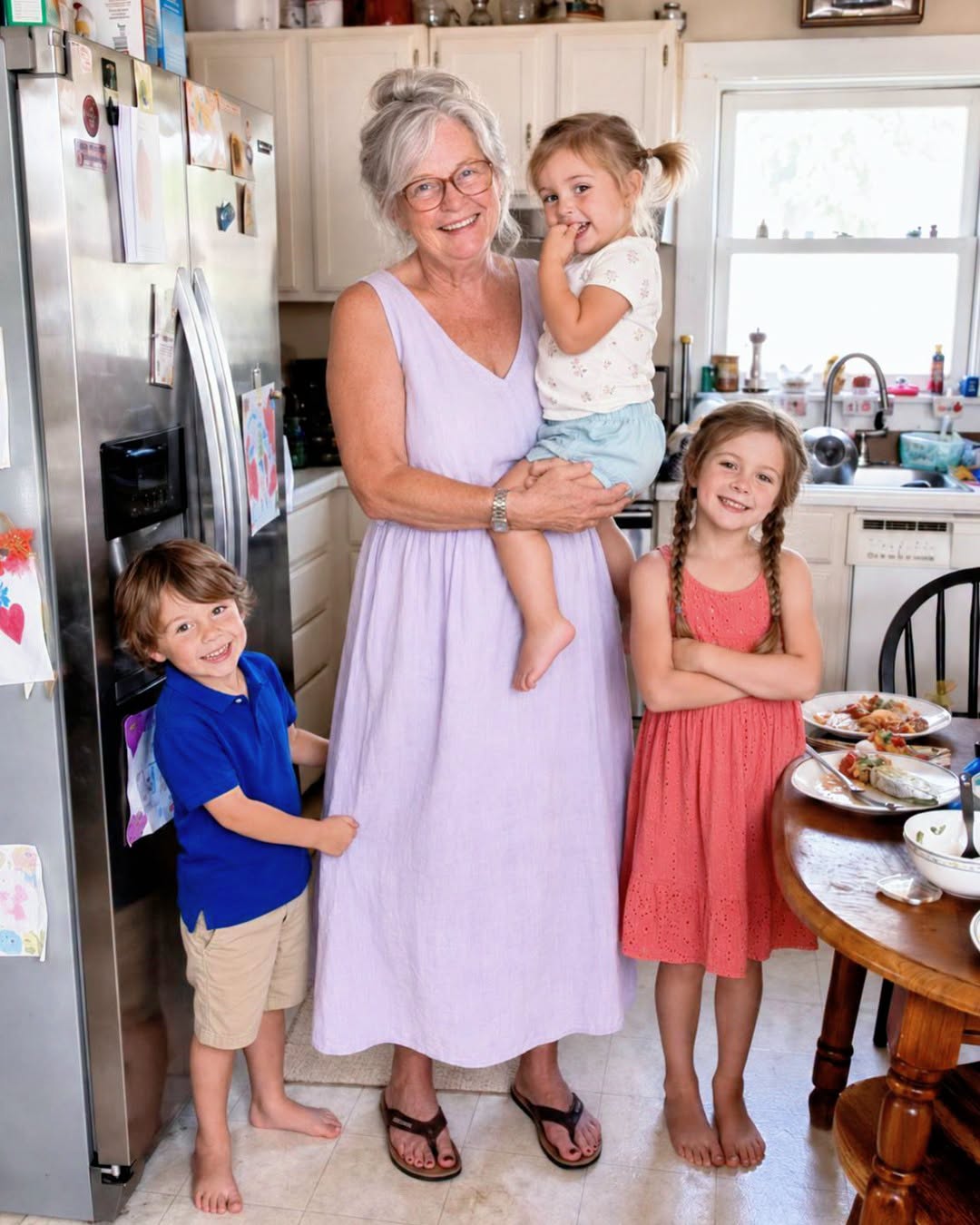
My sister-in-law Rachel’s three children had completely taken over the house.
Seven-year-old Noah was hiding beneath the dining table with a toy clutched against his chest. Five-year-old Emma stood beside an overturned laundry basket, crying as clean clothes spilled across the floor. Two-year-old Caleb had climbed onto a kitchen chair and was waving a wooden spoon above his head like a sword.
In the middle of the chaos stood my mother.
One hand was pressed against her lower back. With the other, she was trying to reach a pot bubbling dangerously on the stove. Cereal covered the kitchen floor, a cup of juice had tipped over near the counter, and the exhaustion on Mom’s face frightened me more than the mess.
She did not look mildly inconvenienced.
She looked completely defeated.
I set the food down and hurried across the room.
“Caleb, sweetheart, come here.”
I lifted him from the chair while Mom closed her eyes and released a long, shaky breath.
“Please turn off the stove,” she murmured. “Before something burns.”
I switched off the burner, moved the pot, and grabbed a towel to stop the juice from spreading.
Mom lowered herself into a chair, wincing as she moved.
“What are Rachel’s children doing here?” I asked.
She avoided my eyes.
“Rachel asked me to watch them for an hour.”
I looked at the clock.
It was nearly six in the evening.
“What time did she bring them?”
Mom hesitated.
“Before eight this morning.”
The towel stopped moving in my hand.
“She has been gone for ten hours?”
“She said she would be quick.”
“How often does this happen?”
Mom rubbed her forehead.
“Not that often.”
“Mom.”
She glanced toward the children as though hoping one of them might interrupt us.
“A few times.”
“A few times a month?”
Her silence gave me the answer.
“Sometimes four,” she whispered.
I stared at her.
Her back had been troubling her for months. On bad days, she struggled to lift grocery bags or stand long enough to prepare a meal. Yet Rachel had been leaving three young children with her for entire days.
“You cannot keep doing this,” I said quietly. “You are in pain.”
“I know.”
“You are their grandmother, not an unpaid nanny.”
Mom gave me a tired, helpless look.
“Then why do you keep agreeing?”
Her mouth tightened.
“Because she appears at seven thirty in the morning with backpacks and tells me she will only be gone for an hour. Then she stops answering her phone. What am I supposed to do? Leave the children standing outside?”
The embarrassment in her voice softened my anger toward her.
Mom had not chosen this arrangement. Rachel had simply learned that if she arrived with the children already dressed and packed, Mom would feel too guilty to refuse.
I picked up Mom’s phone from the counter.
She had sent Rachel six messages.
Are you coming soon?
My back is hurting.
The children need dinner.
Please call me.
Rachel had responded only once.
Relax. I’ll be there later.
No apology.
No explanation.
Not even a question about whether her children were all right.
I placed the phone back on the counter.
“I’m staying until she gets here.”
Mom’s expression immediately filled with concern.
“Kayla, please don’t start a family war.”
From beneath the table, Noah looked up and announced, “Mommy says Aunt Kayla always starts things.”
Despite everything, I almost laughed.
Apparently, Rachel had been discussing me with her children too.

Part Two: The Words That Changed Everything
Rachel finally arrived at 7:15 that evening.
She walked through the door without knocking, dressed in expensive workout clothes and carrying several shopping bags.
She looked relaxed.
Refreshed, even.
Then she saw me standing in the hallway.
“Oh,” she said. “Kayla.”
Her expression suggested that my presence was the inconvenience—not the fact that she had abandoned her children with an exhausted older woman for nearly twelve hours.
“Where have you been?” I asked.
She set one of the bags down.
“Busy.”
“You told Mom you would be gone for an hour.”
“I lost track of time.”
“You left three children here all day.”
Rachel rolled her eyes.
“What is the big deal? We’re family.”
Behind me, Mom began gathering the children’s jackets. She moved slowly, trying not to show how much her back hurt.
I stepped closer to Rachel.
“The big deal is that Mom could barely stand by the time I arrived.”
Rachel glanced at her.
“She looks fine.”
“She is not fine. You’ve been doing this repeatedly, and you have never even offered to compensate her.”
Rachel laughed as if I had made the most ridiculous suggestion imaginable.
“Compensate her? For watching her grandchildren?”
“For giving up entire days with no warning.”
“She’s retired,” Rachel replied. “She sits at home and does nothing anyway.”
The room went completely still.
Mom flinched.
It was a small movement, but I saw it.
After decades of working, raising a family, taking care of a home, and helping everyone who needed her, Rachel had reduced my mother’s life to nothing simply because she no longer had a paid job.
Rachel continued gathering the children’s belongings, unaware—or unconcerned—about the damage her words had caused.
For a moment, I was too angry to answer.
Then I noticed the shopping bags at her feet.
New clothes. Cosmetics. Things she had apparently spent the day choosing while Mom chased a toddler and tried to cook dinner through back pain.
An idea began to form.
Not a cruel idea.
Not revenge.
A demonstration.
I slowly smiled.
“You know what, Rachel? You’re right.”
She blinked.
Mom stared at me.
Rachel straightened. “Excuse me?”
“Family should help family,” I said. “Come to our house tomorrow evening at seven. We’re having dinner.”
Her eyes narrowed.
“Why?”
“I think the family needs to discuss how we can support one another.”
Her suspicion faded into satisfaction.
“Finally,” she said, smirking. “You’re beginning to understand.”
She guided the children toward the door.
Before leaving, she looked over her shoulder and added, “Make something the kids will actually eat.”
When the door closed, Mom turned to me.
“What are you planning?”
I bent down and picked up the cereal bowl Caleb had knocked over.
“Nothing cruel,” I promised. “I’m simply going to help Rachel understand the value of someone else’s time.”
Part Three: The Family Favor Plan
The next morning, I called my husband, Mark.
He listened quietly as I explained what I had seen and repeated what Rachel had said about Mom.
When I finished, he sighed.
“How long has she been doing this?”
“I don’t know yet. Mom records appointments on her kitchen calendar. I’m going to check it tonight.”
Mark was silent for a moment.
“My sister is going to explode when she realizes what you’re planning.”
“Probably.”
“Do you want me to stop you?”
“No.”
“Good,” he said. “Because I don’t.”
By lunchtime, several relatives had agreed to participate.
Aunt Linda volunteered first. Uncle Paul laughed so hard when he heard the idea that he had to put the phone down before he could answer. Two cousins offered to create their own imaginary obligations.
No one wanted to punish Rachel.
They simply wanted her to experience what Mom had been experiencing: the helpless feeling of discovering that someone else had already claimed your time without bothering to ask.
By 6:30 the following evening, nearly every adult in the family was sitting around my dining table.
Mom sat beside Mark, twisting a napkin nervously in her hands.
Behind us, taped across the wall, was an enormous calendar.
Across the top, in bold letters, I had written:
THE FAMILY FAVOR PLAN
Rachel’s name appeared in nearly every square for the next three months.
On one Saturday, she was scheduled to clean Aunt Linda’s house.
The next weekend, she was expected to drive Uncle Paul to several appointments.
One cousin had assigned Rachel to babysit four children for an entire day.
Another had written that Rachel would prepare dinner for a family gathering of sixteen people.
There were grocery trips, errands, school pickups, laundry, gardening, and weekend childcare.
Nearly every available hour had been claimed.
I looked around the table.
“Remember, no one actually expects her to do any of this.”
Aunt Linda nodded.
“We’re making a point, not assigning a punishment.”
At 7:12, Rachel opened the door without knocking.
“Sorry, traffic was—”
She stopped.
Her gaze moved from the crowded table to the calendar hanging on the wall.
“What is that?”
No one answered.
Rachel stepped closer and began reading.
As she moved from one square to the next, her face changed.
Confusion became disbelief.
Disbelief became anger.
Finally, she spun around.
“Why is my name everywhere?”
I stood.
“We’ve created a family schedule.”
“You created a schedule for me?”
“We all contributed.”
She pointed toward the calendar.
“You volunteered me for three months without asking?”
I held her gaze.
“That is exactly the question Mom has been afraid to ask you.”
The room became silent.
Rachel looked toward my mother, then quickly turned back to me.
“This is ridiculous.”
“Is it?”
“Yes! I have children. I have a job. I have responsibilities. I cannot spend every weekend doing favors for everyone else.”
Aunt Linda leaned forward.
“Why not? We’re family.”
Rachel frowned.
“That’s different.”
“How?”
“Because I already have a full life.”
Aunt Linda’s expression remained calm.
“And so does your mother.”
Rachel crossed her arms.
“She’s retired.”
“Retired does not mean available,” Aunt Linda replied. “It means she worked for years and finally reached a point where her time belongs to her.”
Rachel glanced at Mom.
“But she loves my children.”
Mom’s voice was quiet.
“I do love them.”
Rachel spread her hands triumphantly.
“There. You see?”
Mom looked down at the table.
“That does not mean I can care for them all day whenever you decide.”
Rachel’s expression shifted.
For the first time that evening, she seemed uncertain.

Part Four: Nineteen Visits in Eight Weeks
Mark looked at his sister.
“How often have you been leaving the children with Mom?”
Rachel shrugged.
“Occasionally.”
“How often?”
“Maybe once a week.”
I walked into the kitchen and returned carrying Mom’s calendar.
I placed it on the table and opened it.
“Eight weeks,” I said. “Nineteen visits.”
Rachel stared at the pages.
“That cannot be right.”
I began reading.
“Tuesday, 7:48 a.m. until 6:15 p.m.”
I pointed to the next entry.
“Thursday, 8:10 a.m. until 5:40 p.m.”
Then another.
“Saturday, nine in the morning until dinner.”
Each entry told the same story.
Rachel had arrived claiming she needed help for an hour or two. Then she had disappeared for most of the day.
Mark’s face tightened.
“Those are not occasional favors.”
Rachel’s cheeks turned red.
“Mom could have said no.”
Everyone looked at her.
Mom placed both hands on the table.
“You are right,” she said.
Rachel blinked.
Mom continued, her voice firmer this time.
“I should have said no. I was afraid you would become angry or keep the children away from me. But I should have spoken sooner.”
She took a breath.
“Starting now, I will.”
Rachel’s anger seemed to falter.
I walked to the wall and carefully removed the enormous calendar.
“Nobody expects you to complete these tasks,” I explained. “We wanted you to feel what Mom feels when you arrive with her entire day already decided for her.”
Uncle Paul removed his appointment card.
Aunt Linda peeled away the note about cleaning her house.
My cousins removed the childcare requests.
One by one, the crowded calendar became blank.
Rachel watched in silence.
“This was a demonstration,” I said. “But the problem is real. You still need childcare, and Mom needs boundaries.”
She looked down at the empty squares.
For once, she had nothing sharp to say.
Part Five: A Schedule Built on Respect
We spent the next hour creating a real plan.
Mark called Rachel’s husband, Evan, and put him on speakerphone. He admitted that he had not realized how often Rachel was leaving the children with Mom.
After checking his work schedule, he agreed to adjust one weekday so he could handle school pickup himself.
Rachel found an after-school program with openings on Tuesdays and Thursdays.
Mom offered to watch the children one afternoon every other week.
Rachel immediately looked up.
“Only one afternoon?”
Mom did not retreat.
“One planned afternoon every other week,” she repeated. “Because I want to see them. Not because someone assumes I have nothing else to do.”
Rachel stared at her.
“So I have to call first?”
“Every time.”
“What if it’s an emergency?”
“A real emergency is different,” Mom said. “Shopping, appointments, exercise classes, and losing track of time are not emergencies.”
Rachel pushed her chair back.
She collected her purse and left before dessert.
No one followed her.
For several seconds after the door closed, the room remained silent.
Then Mom released a breath that sounded as though she had been holding it for months.

Part Six: The First Sign of Change
Three days later, Rachel called me.
I nearly ignored the call because I expected another argument.
When I answered, I could hear Caleb crying in the background.
“He wants Grandma,” Rachel said.
I waited.
“I told him we cannot simply go to her house.”
“And?”
“He asked why.”
“What did you tell him?”
Rachel paused.
“I said Grandma has plans.”
I leaned back in my chair.
“Good.”
“Sometimes she probably doesn’t have plans,” Rachel muttered.
“Resting can be a plan.”
The line went quiet.
Then Rachel said softly, “I know.”
They were only two words, but they mattered.
“You can ask Mom about another day,” I said.
“I already texted her.”
“And?”
“I’m waiting for her to answer.”
That was the first real change.
Rachel was waiting.
She was allowing Mom to choose.
The new arrangement was not perfect, but over the following weeks, it held.
Rachel called before visiting.
Evan handled one weekday.
The after-school program covered two afternoons.
Mom stopped keeping her phone beside the shower because she was afraid Rachel might suddenly appear at the door.
She began taking afternoon walks again. She joined a small gardening group at the community center. Some days, she simply sat by the window with a cup of tea and a book.
Most importantly, her back gradually improved because she was no longer carrying Caleb for ten hours at a time.
She still adored the children.
But now, when they visited, she had the energy to enjoy them.
Part Seven: The Apology That Finally Mattered
Several weeks later, Rachel came to Mom’s house and asked to speak with her privately.
I happened to be visiting, but I stayed in the living room while they talked in the kitchen.
Their voices remained low.
There was no shouting.
No defensive laughter.
No one stormed out.
About ten minutes later, Rachel walked into the living room. Her expression looked different. The sharpness she usually carried was gone.
Mom followed her, holding a printed monthly calendar.
Only two afternoons had been circled in blue ink.
Later, Mom told me what had happened.
Rachel had sat across from her at the kitchen table and said, “I treated your free time as though it belonged to everyone.”
Mom had remained quiet.
Rachel continued.
“I kept telling myself that you would say no if you really minded. But the truth is, I made it difficult for you to say no. I brought the children here first and asked questions afterward.”
She did not cry.
She did not make a dramatic speech.
Instead, she slid the calendar across the table.
“Please circle the days when you would actually enjoy seeing them.”
Mom circled two afternoons.
Rachel looked at the dates and nodded.
“Okay.”
She did not ask for additional days.
She did not bargain.
She did not add another favor at the last minute.
She accepted Mom’s answer.
The enormous Family Favor Plan still sits folded in my hallway closet behind the winter coats.
I kept it because a part of me believed we might need it again.
So far, we have not.
At our next family dinner, Rachel glanced toward the closet and shook her head.
“That was the most irritating lesson anyone has ever taught me.”
Aunt Linda smiled.
“Did it work?”
Rachel was serving mashed potatoes. She lifted the spoon toward Mom’s plate, then stopped herself.
“Would you like some more?” she asked.
Mom considered the question for a moment before nodding.
“Yes, please.”
Rachel placed another spoonful on her plate.
Then she looked at Aunt Linda.
“Yes,” she admitted. “It worked.”
Nobody applauded.
Nobody made a speech.
We did not need to.
For the first time, Rachel had asked instead of assumed.
And sometimes, that simple question is the difference between helping someone you love and taking advantage of them.
Note: This story is a work of fiction inspired by real events. Names, characters, and details have been altered. Any resemblance is coincidental. The author and publisher disclaim accuracy, liability, and responsibility for interpretations or reliance. All images are for illustration purposes only.