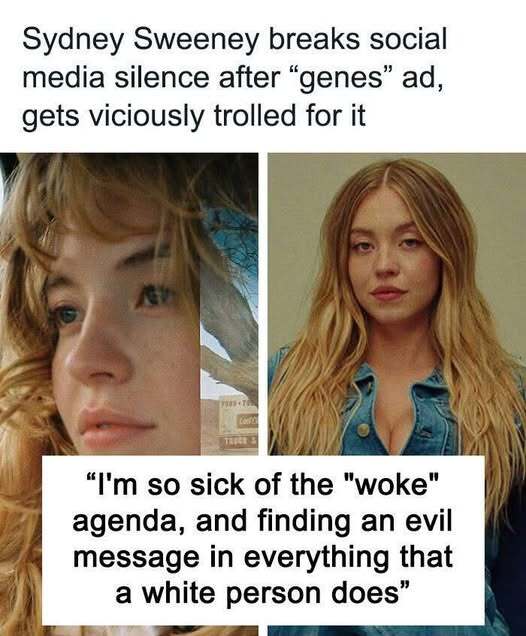
Sydney Sweeney’s return to social media was supposed to be simple, soft, and unremarkable—a small collection of behind-the-scenes photos from her upcoming film Americana, captioned with a cheerful note about “a project I filmed with friends.” But nothing about her online presence is simple anymore, not in an era where celebrity posts are dissected frame by frame, where every word is filtered through millions of interpretations, and where backlash surges faster than applause. For nearly a month she had disappeared, stepping back from a web of noise she did not publicly address. Fans assumed she was taking a mental health break, or focusing on new roles, or simply unplugging. Yet the moment she resurfaced, the comments began pouring in—many supportive, yes, but others sharp enough to cut, dripping with accusation, anger, and demands that she be “held accountable.” What was supposed to be a harmless post turned into a lightning rod for frustration that had been simmering ever since her controversial American Eagle ad aired, an ad that became the center of a storm she had never intended to create.
The ad itself was simple, even playful. Standing in denim, she said, “My jeans are blue,” followed immediately by a cheeky voiceover declaring, “Sydney Sweeney has great jeans.” To the marketing team, it was a harmless joke built on a pun so old it belonged to playground banter. But in the age of instantaneous outrage, the joke mutated into something far more sinister in the eyes of critics who insisted the wordplay had been crafted to imply “genetic superiority.” Conspiracy threads sprang up in corners of the internet where context rarely survives. Others dismissed the outrage entirely, arguing that the ad was not racist but objectifying, reducing Sydney’s body to a billboard whose value lived in the shape of her thighs. A few comments under her Americana announcement captured the divide perfectly. “Perfect, won’t be watching it,” one user spat, tagging three friends who promptly joined the bullying chorus. Meanwhile, another wrote gently, “Do your thing, Sydney. People will twist anything.” And in that tangled chaos—praise and condemnation wrapped together—Sydney found herself again trapped between fame’s bright glow and its unforgiving shadows.
Meanwhile, the conversation surrounding her new film Americana became tangled in the backlash. The movie, which follows a violent conflict over a stolen Native American artifact known as a ghost shirt, was already drawing mixed reviews from early screenings. Some praised its raw performances and tension-filled pacing; others criticized its depiction of cultural history and questioned whether the film handled its themes with adequate sensitivity. Sydney’s role was central to the story, and under normal circumstances, her fans would have been buzzing about her dramatic range. But now, her movie announcement had been hijacked by a growing boycott movement. Hashtags urging people to skip the film appeared beneath her post, some calling for accountability, others simply enjoying the chaos. What stung most deeply was knowing that many of these angry commenters had never seen the film, nor the ad in full, nor any of the context. Their outrage wasn’t personal—they didn’t know her—but it was loud, persistent, and relentless. Fame had elevated her, yes, but it also pinned her to a wall where she could not control the narrative swirling around her.
Yet even in the midst of the storm, something else began to unfold—something quieter, softer, and surprisingly stabilizing. Fans who had been silent during the chaos began to speak up, offering words of encouragement and empathy. Some shared their own experiences being misunderstood or misrepresented online. Others reminded her that fame magnifies everything, turning whispers into headlines. A few simply said, “We’re still here.” Their voices didn’t drown out the negativity, but they gave Sydney something real to hold onto. They reminded her that the public is not a single, angry organism but a collage of individuals—some cruel, some kind, most simply human. They reminded her that a single controversy does not define a career, and that navigating fame is, in many ways, learning to let go of what you cannot control. As days passed, the noise began to settle. The boycott hashtags lost momentum. The ad faded beneath the next outrage-cycle headline. And Sydney, though changed by the experience, stood ready to step forward again with a resilience sharpened by adversity.
By the time Americana hit theaters on August 15, the storm had quieted just enough for her to breathe again. Critics debated the film on its own merits rather than through the lens of the controversy, and audiences filtered into theaters with curiosity rather than hostility. Sydney herself chose not to address the ad publicly, a decision rooted not in avoidance but in the belief that sometimes silence is not guilt—it is grace. She focused instead on her work, her craft, and the loyal community that continued to support her. The ordeal left scars, the kind no makeup trailer could cover, but it also left perspective. Fame is fragile. Public favor is fleeting. But authenticity—however flawed, however human—tends to endure. And in the end, that is what Sydney Sweeney walks away with: the understanding that she cannot control interpretation, she cannot stop outrage from spreading, but she can remain herself. The world will twist what it wants, but her truth remains steady beneath it all: she showed up, she worked hard, she acted in good faith, and she learned. And in the volatile landscape of modern celebrity, that quiet resilience may be the most powerful statement of all.