
 The Latest: Russia warns it will bring about the ‘end of the world’ if Trump…See more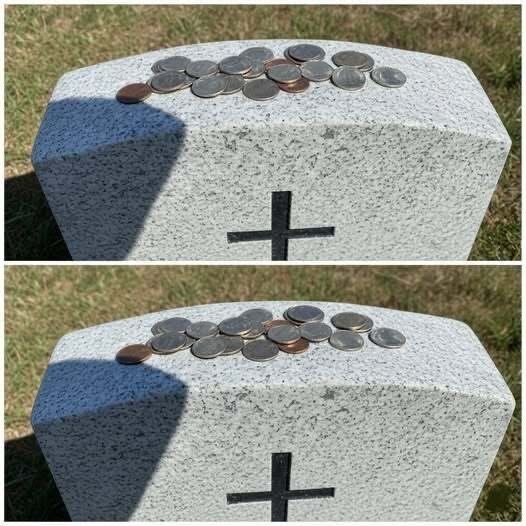
The sight of a small coin resting quietly atop a gravestone often goes unnoticed by hurried visitors, yet for those who understand its meaning, that single object speaks a language richer than words. Long before formal explanations appeared on plaques or websites, the act of leaving coins at graves emerged as a subtle form of communication, especially within military cemeteries. It is a tradition built not on spectacle but on restraint, humility, and shared understanding. A penny may signal that someone simply stopped by, that the deceased was not forgotten that day. A nickel suggests a deeper bond, a connection forged during training. A dime carries the weight of shared service, while a quarter conveys perhaps the heaviest message of all: “I was there when they died.” Each coin becomes a sentence in a silent conversation between the living and the dead. Unlike flowers that fade or flags that are ceremonially removed, coins remain grounded, modest, and intentional. They resist sentimentality while still carrying profound emotional gravity. This practice reminds visitors that remembrance does not need to be loud to be meaningful. In military culture especially, where restraint and discipline are prized, the coin is a fitting symbol. It honors service without embellishment, grief without spectacle, and loyalty without expectation of recognition. The tradition transforms a cemetery from a static place of loss into an active space of ongoing connection, where stories continue to be told not through speeches but through metal left behind by those who remember.
The origins of placing coins on gravestones are often traced through overlapping histories, myths, and evolving customs. Some link the practice loosely to ancient traditions, such as the Greek custom of placing coins with the dead to pay Charon for passage across the River Styx. Others point to more modern military history, particularly during times of war when fallen soldiers were buried far from home and families feared they might never know their loved one was remembered. In these contexts, coins became proof of presence. During the Vietnam War era, the practice took on a more structured meaning among U.S. service members, who developed a shared understanding of what each coin signified. Leaving a coin allowed comrades to honor the dead without the discomfort of direct contact with grieving families, particularly in cases where emotions, politics, or guilt complicated communication. Over time, this silent code spread beyond military circles and became recognized by the public, though its deepest resonance still lies within those who served. Importantly, the tradition also took on a practical dimension. The coins collected by cemetery staff are often used to help maintain the grounds, subtly contributing to the care of the graves without placing additional financial or emotional burden on families. In this way, the act blends symbolism with responsibility, turning remembrance into action. The simplicity of the gesture ensures its longevity. Coins are accessible, universal, and durable. They do not wilt, shatter, or require explanation. Their value lies not in their monetary worth but in the intention behind their placement, a reminder that memory itself is a form of service.
What makes this tradition especially powerful is its layered meaning, understood differently depending on who encounters it. For a fellow veteran, a coin on a grave may immediately signal that someone who shared hardship, fear, and responsibility has come to pay respects. For family members, discovering coins left behind can bring a complex mix of comfort and sorrow. There is reassurance in knowing that their loved one’s life mattered beyond the family circle, that bonds formed in service endured beyond death. At the same time, each coin is a reminder of the experiences the deceased lived through, some of which families may never fully know. The quiet dignity of the practice allows space for these emotions without forcing confrontation. Unlike written notes or spoken messages, coins do not intrude. They coexist with grief rather than competing with it. Even for civilians unfamiliar with the tradition, the presence of coins often sparks curiosity, leading to conversations and learning that extend remembrance further. In this way, the practice acts as a bridge between generations and communities. It educates without lecturing and honors without demanding participation. The grave becomes not just a marker of death, but a focal point of shared history. Each coin adds another layer to that history, building a collective narrative of service, sacrifice, and solidarity that transcends individual lives.
The symbolic hierarchy of the coins themselves reflects the values embedded in military culture. A penny, the smallest and most common coin, signifies presence without presumption. It says, “I was here, and I remembered.” A nickel, indicating training together, speaks to shared beginnings, to the formative period when strangers became a unit. A dime, representing shared service, acknowledges time spent in uniform together, perhaps across deployments or years of duty. The quarter, reserved for those who were present at the moment of death, carries a gravity that few other gestures can match. It is not dramatic, yet its meaning is immense. It recognizes the ultimate proximity to loss, the burden of witnessing a comrade’s final moments. This structured symbolism mirrors the military’s reliance on codes, ranks, and shared understanding. It allows complex emotions to be expressed through simple means. Importantly, the system is not rigidly enforced. No one checks which coin is left, and no one demands explanation. The meaning exists because people agree to honor it, not because it is written in rules. That voluntary respect is what gives the tradition its strength. It operates on trust, on the belief that those who participate do so with sincerity. In an era where public expressions of grief can sometimes feel performative, the coin tradition stands apart as something deeply personal, even when witnessed by others.
Beyond individual graves, the practice contributes to the atmosphere of military cemeteries as a whole. Walking among rows of headstones marked by occasional glints of metal creates a sense of ongoing presence. It suggests that the cemetery is not abandoned to the past but actively visited, cared for, and remembered. The coins tell a story of movement: people coming and going, stopping briefly, kneeling, thinking, leaving something behind. This quiet activity contrasts with the stillness of the stones themselves, creating a powerful emotional tension. Cemetery staff play a crucial role in sustaining this balance. By collecting the coins and using them to support maintenance, they become participants in the tradition rather than mere caretakers. The gesture ensures that remembrance contributes directly to preservation, reinforcing the idea that honoring the dead also means caring for the spaces they occupy. Families, in turn, are spared the knowledge that their loved one’s grave requires extra attention or expense. The tradition thus creates a closed loop of respect, where visitors honor the dead, staff maintain the grounds, and families find comfort in both. It is a system built not on obligation but on mutual care, reflecting the communal values that military service itself is meant to uphold.
Ultimately, the enduring power of leaving coins on gravestones lies in its quiet resistance to forgetting. In a world saturated with noise, images, and declarations, the tradition asks almost nothing of the participant except thoughtfulness. It does not require eloquence, wealth, or even personal familiarity, only a willingness to pause and acknowledge another life. That pause is the heart of remembrance. Each coin marks a moment when time slowed, when someone chose to engage with memory rather than pass by it. Over decades, those moments accumulate, turning cemeteries into landscapes shaped as much by living memory as by stone. The tradition also serves as a reminder that honor is not confined to official ceremonies or national holidays. It can be practiced quietly, individually, and at any time. By leaving a coin, a person participates in a lineage of respect that stretches backward to those first silent gestures and forward to future visitors who will notice and learn. The coins will be collected, the graves maintained, and the cycle will continue. Yet the meaning endures precisely because it is never fully fixed. Each participant brings their own story, their own reason for stopping, their own understanding of what respect looks like. In that openness, the tradition remains alive, a small but profound testament to how memory, service, and humanity can coexist in the simplest of acts.